
From Paris 1889 to Ghent 2026:The Raqs Sharqi Museum Opens Its First MajorExhibition

Rare antiques, signed photographs, and newly acquired treasures go on public display at
Leylet Raqs Heritage Festival in Ghent, Belgium — the first exhibition dedicated to the
history of Raqs Sharqi.
By Lenka Badriyah
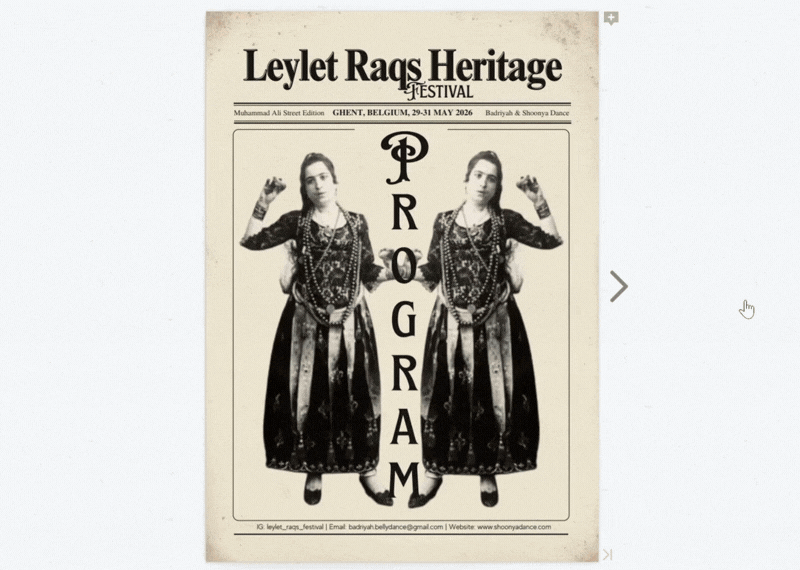
Imagine holding a photograph that is over a hundred years old. The paper is thick
and slightly yellowed. The edges are soft from time. And there, looking back at you, is
an Egyptian dancer — her pose confident, her costume catching the light of a long-
gone studio. She performed for audiences who are no longer alive. The stage she
danced does no longer exist. But she is still here, in this photograph, as vivid and
present as the day the shutter clicked.
This is what it feels like to hold the items of the Raqs Sharqi Museum.

For the past six years, I have been gathering antique items that depict Egyptian dancers
across the centuries — fragile newspapers, vintage postcards, original photographs,
engravings, vinyl records, books, movie ephemera, and personal artefacts belonging
to legendary performers. Piece by piece, the collection has grown to over 400 items,
forming what I have named the Raqs Sharqi Museum.
A fraction of the collection can be explored online at the museum’s website, but the most
exquisite items have never been published. This May, for the first time, a major selection
of these treasures will go on public display at the Leylet Raqs Heritage Festival in Ghent,
Belgium (29–31 May 2026) — the first exhibition of its kind dedicated entirely to the
history of Raqs Sharqi. While some individual items may have appeared in other
contexts before, this is the first time they will be presented together in a setting that
highlights their significance for dance history.
The Raqs Sharqi Museum: Preserving What Time Is Erasing
The goal of the museum is urgent and simple: to find, preserve, and share the
physical traces of a dance heritage that is disappearing. Every old newspaper that
crumbles, every photograph that fades, every vinyl record that cracks takes with it a
piece of evidence about how this dance was performed, perceived, and celebrated.
The museum is organised into three collections. The Pre-Golden Era in Egypt covers
items from the early 18th century to approximately 1910, including antique
engravings, stereoviews, postcards, and photographs from Egypt and from the
famous World’s Expositions. The Golden Era in Egypt spans the 1930s through the
1970s — the decades of Cairo’s vibrant cabaret scene, the explosion of the Egyptian
film industry, and the rise of the iconic dancers whose names still define this art
form. The Western World & Bellydance collection explores how Egyptian dance was
interpreted, reimagined, and sometimes distorted by Western performers and
audiences from the Belle Époque onward.
Newly Acquired Treasures
The Leylet Raqs Heritage exhibition will feature items from across all three
collections, but I am particularly excited to present several recent acquisitions that
are among the rarest and most significant items the museum has ever obtained.
The Exposition Universelle, Paris 1889

The Exposition Universelle of 1889 in Paris — the same World’s Fair that gave the
world the Eiffel Tower — also introduced European audiences to Egyptian dancers,
singers, and musicians performing live at the Café Égyptien. Their performances
caused a sensation, captivating visitors with a form of dance most had never
witnessed.
The museum has acquired an original vintage stereoview of the Café Égyptien at the 1889 Exposition — a three- dimensional photographic format popular in the 19th century — as well as an original large- format photographic print showing Egyptian dancers, singers, and musicians who famously created enormous excitement among the Parisian audience. These are original items from 1889, extremely rare survivals that place you directly at the moment when Egyptian dance first electrified the Western world.
The exhibition will also include period newspapers reporting on the appearance of
Egyptian dancers at the 1889 Paris Exposition — contemporary accounts that reveal
how this dance was described, debated, and marvelled at by European observers.
Original Silver Prints by Gabriel Lekégian Gabriel Lekégian was a renowned Cairo-based photographer of Armenian origin,
active in the late 19th century, whose work documented Egypt and its people with
remarkable artistry. The museum has acquired two original albumen silver prints by
Lekégian: one depicting a dancer performing at an Egyptian theatre, connected to the
World’s Columbian Exposition in Chicago in 1893, and another showing an Egyptian
dancer posing with two swords — a striking image that speaks to the skill and
spectacle of these performers. Items of this nature are exceptionally rare on the
market today.
Signed Photographs: The Personal Traces of Legends
Among the most precious items in the exhibition are original signed photographs of Samia Gamal, Suheir Zaki, Hagar Hamdi, and Nahed Sabry. Each signature is a direct, intimate
trace left by the hand of a legendary performer — a personal mark that transforms a photograph into something irreplaceable. In a world where we experience these dancers
primarily through old film clips and secondhand stories, holding a signed photograph is as close as we can get to standing in their presence.

Alongside these, the exhibition will display an extraordinary document: an original receipt from a movie company bearing the signature of Nagwa Fouad — her payment for a film she danced in. It is the kind of item that was never meant to survive, never meant to be seen by anyone beyond an accountant's desk. And yet here it is — a small, fragile piece of
paper that places you inside the working life of one of Egypt's greatest dancers.
A Journey Through Centuries: What Else Awaits
Beyond the new acquisitions and signed photographs, the exhibition presents
treasures spanning several centuries of dance history.

Visitors will encounter rare antique engravings from the 18th century depicting dancers from
Egypt — some of the oldest visual records of the tradition that would eventually become raqs sharqi. Original silver prints showing the portrait of Shafiqa El Koptiya, one of the most famous Egyptian dancers and entertainers of the late 19th and early 20th century, will be on display.
The Golden Era comes alive through original movie brochures featuring Tahia Carioca, whose earthy, grounded style defined an entire school of raqs sharqi; Naima Akef, the acrobatic prodigy with extraordinary physical abilities; Samia Gamal; Naemat Mokhtar, known for her iconic hip movements and remarkable musicality; and Suheir Zaki.
Old advertisements for Saala Badia will transport visitors to the glamorous world of 1930s and 1940s Cairo. Badia Masabni was the ultimate influencer of her time — she
owned the famous Casino Opera and Saala Badia on Emad al-Din Street, where she launched the careers of both Tahia Carioca and Samia Gamal and helped transform
Egyptian dance into the art form we recognise today.
Among the most atmospheric moments of the exhibition will be vinyl records of Badia

Masabni’s monologues played on a vintage record player during the museum’s grand
opening on Friday evening — filling the space with the actual voice and music of this
extraordinary era. Visitors will also see old books, including a volume on the famous
Kuchuk Hanem — the dancer who captivated Gustave Flaubert during his travels in Egypt
— as well as vintage postcards, 19th-century finger cymbals, and the personal tiara of
Suheir Zaki.
Every item in this exhibition is an original. None are reproductions. And given the
fragility of many of these pieces, an exhibition of this scope may not be possible
again.
The Leylet Raqs Heritage Festival: More Than an Exhibition
The museum exhibition is the centrepiece of the Leylet Raqs Heritage Festival, a
three-day gathering dedicated to the history, heritage, and living traditions of Raqs
Sharqi, taking place 29–31 May 2026 at Shoonya Dance Centre in Ghent, Belgium.
The festival programme includes lectures and dance workshops by Nisaa (Heather D.
Ward), one of the world’s leading researchers of Egyptian belly dance history and
author of Egyptian Belly Dance in Transition and Raqs in the City, alongside Reda
Henkesh, a master tabla player from Cairo’s legendary Muhammad Ali Street and
lead percussionist for Muhammad Mounir. Italian-Egyptian dancer and researcher
Nada Al Basha leads workshops exploring the authentic roots of Egyptian baladi and
dance as resistance through the music of Sheikh Imam. The weekend also features a
documentary screening, a gala theatre show, a guided tour through historic Ghent,
and a closing circle.
Beyond the programme, festival visitors can browse and purchase handmade
vintage-inspired costumes by legendary Egyptian designer Eman Zaki, book a
personalised Golden-Era-inspired photoshoot with renowned dance photographer
Tunde Dora, or simply relax in the Golden Era Corner — a cosy space where vintage
film clips play throughout the weekend alongside original Golden Era magazines and
translated excerpts.

Would you like to participate?
We would love to welcome you both in person and online!
In person: Full weekend passes, day passes, and individual workshop registrations
are all available. Whether you come for the entire festival or a single session, the
experience includes access to the museum exhibition and all the festival’s unique
offerings. Dance teachers interested in bringing their students can contact the
organisers directly for special group options.
Online from anywhere in the world: For those who cannot travel to Ghent, all
three festival lectures will be streamed live via Zoom. Recordings will be available for
two weeks after the festival, so you can watch and rewatch at your own pace.
Individual lectures and a discounted Online Package covering all three lectures are
both available.
Full programme and registration: www.shoonyadance.com/leylet-raqs-festival
Supporting the Raqs Sharqi Museum
The Raqs Sharqi Museum is an independent, self-funded project. Every item in the
collection has been personally acquired, and the museum relies on the support of its
community to continue growing and preserving these irreplaceable pieces of dance
heritage. You can support the museum by becoming a patron, by visiting the online
collection, or — best of all — by coming to see these treasures in person in Ghent this
May.
Because some things only exist when you’re standing in front of them.
Leylet Raqs Heritage Festival | 29–31 May 2026 | Shoonya Dance Centre, Ghent,
Belgium
The Raqs Sharqi Museum: www.badriyahbellydance.com/raqs-sharqi-museum
Support the museum: www.patreon.com/raqssharqimuseum
Comments